For the first time,
you can see your
ADHD brain.
Not ADHD in general. Not the version that works for the person who wrote the productivity book. Yours. Your specific patterns, your first domino, your strengths, your saboteurs — mapped on a canvas so you can finally design something that fits.
You are not the problem.
The design is.
Every system you have tried was designed for a different kind of brain. The colour-coded planner. The time-blocking app. The morning routine in the bestselling self-help book. They were not designed for your specific relationship with task initiation, or your particular patterns of emotional flooding, or the exact way your saboteurs show up in your daily life. ADHD is not a discipline problem. It is a design problem. And the solution is not to try harder with the wrong system. It is to design a better one.
Generic systems built for the average user. Neurotypical assumptions baked into every feature. Failure treated as a personal shortcoming rather than a design mismatch.
You were not failing. You were a user of systems that were not designed for you. You were a designer who did not yet have enough information about the brain you were designing for.
You move from being a passive user of systems that do not fit, to being the active designer of systems that do. Built on your specific strengths, barriers, and first domino.
U.M.P.A.R. — the five reasons other systems stop working, and what to do instead.
Built from the fusion of design thinking and ADHD coaching. Each stage exists because something specific breaks without it.
Understand & UncoverWithout this: you keep solving the wrong problem.
Executive function challenges rarely arrive alone. They form chains — one difficulty triggering another, and another, until you are addressing the missed deadline when the chain started three steps earlier with an emotional response. The Understand stage finds your first domino. Not ADHD in general. Your specific chain, your specific brain.
Maintain & MoveWithout this: a good plan executed by a depleted brain will fail. Every time.
The ADHD brain starts every negotiation between the chimp and human brain at a disadvantage — with less neurochemical fuel in reserve. Most systems skip straight to planning without asking whether the brain has what it needs to execute. Maintain builds the daily habits that keep the human brain resourced enough to do the work.
Plan & PrioritiseWithout this: generic solutions built for someone else's brain.
The productivity book does not know your Avoider saboteur or how emotional flooding depletes your task initiation capacity. The Action Canvas does. Plans here are built around your specific barriers, your strengths used as a lens, and your emergency plan for when things go sideways — because they will, and that is designed for, not apologised for.
Action & AccountabilityWithout this: insight happens in the session. You leave motivated and do nothing.
In most ADHD coaching, the clarity lives in the conversation. The Canvas changes that. Every plan you build converts directly into tasks and daily reminders inside a task management system — so the structure exists on an ordinary Tuesday morning when motivation is long gone and you need the system to carry you, not the other way around.
Reflect & RepeatWithout this: deviation gets treated as failure and the shame compounds.
A linear system has no place to put a plan that did not work except the shame bin. The UMPAR loop is different. Deviation is data. Every experiment that does not work tells you something that makes the next design more accurate. The colour-coded planner you abandoned after ten days was not failure. It was a prototype. The review stage helps you read it that way.
The framework made visible. And actionable.
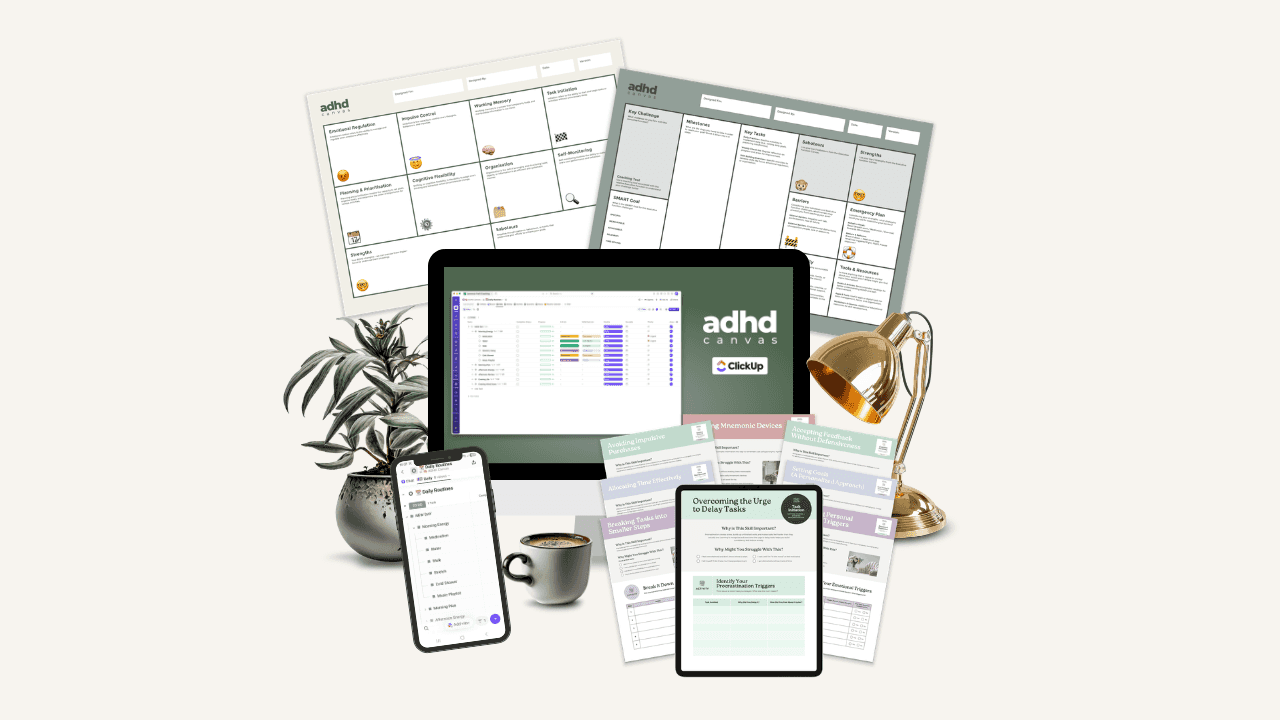
Things that are impossible to see inside someone's head become clear on a canvas. Patterns that were invisible become obvious. The first domino becomes identifiable.
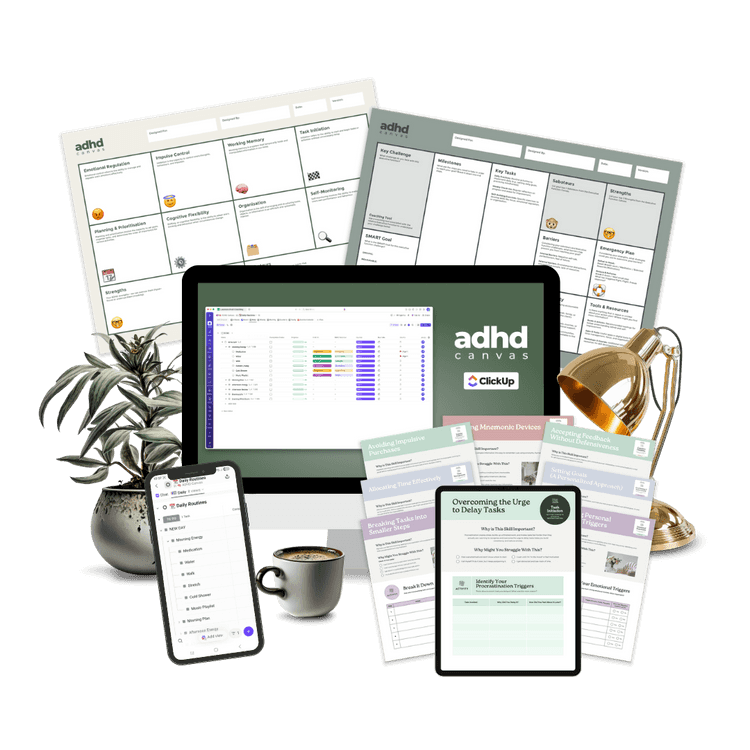
The Canvas is not just a visual tool. Everything on it converts directly into tasks and daily reminders — so insight does not stay in the session. It becomes the scaffolding for an ordinary Tuesday.
OVERVIEW CANVAS
8 executive functions. Strengths and saboteurs as the lens. 5 slots to find your first domino.
ACTION CANVAS
SMART goal, milestones, barriers, emergency plan — built around your brain, not a generic template.
TASK INTEGRATION
Canvas sticky notes become tasks and daily reminders. Plans do not stay on the canvas.
50+ COACHING TOOLS
Eisenhower Matrix, River of Ideas, Emergency Backpack, RSD regulation, and 46 more.
Understanding your brain comes before managing it.
The free course walks you through the neuroscience, the framework, and the practical tools in 10 short modules. Everything you need to understand your specific ADHD brain before you try to build a system for it.
- Why your brain runs out of fuel faster, and what to do about it
- The 8 executive functions and exactly how ADHD disrupts each one
- The U.M.P.A.R. framework introduced in full
- Your Emergency Backpack for when overwhelm hits
- Private community access included

You know which parts of your business you avoid. Let's automate them.
Once you understand how ADHD affects your executive function, you can see exactly which business tasks you will consistently avoid. The Automation Blueprint maps your entire business visually — so you know precisely where to build automated support. The result: AI assistants that sound like you, a pipeline that runs without you, and a 14-day free trial to build it in immediately.
See the BlueprintAFTER THE ADHD CANVAS
You know your executive function weak spots. Now map your business against them — and automate the areas ADHD makes hardest.
THREE DOCUMENTS
Business Strategy Doc, Pipeline & Automation Map, Brand Voice Guide. AI that knows your business and sounds like you.
BUILD IMMEDIATELY
£47. Includes GoHighLevel 14-day free trial and the ADHD Entrepreneur snapshot, pre-configured and ready.
Start free, or go straight to
the system.
Wherever you are, there is a starting point that fits.
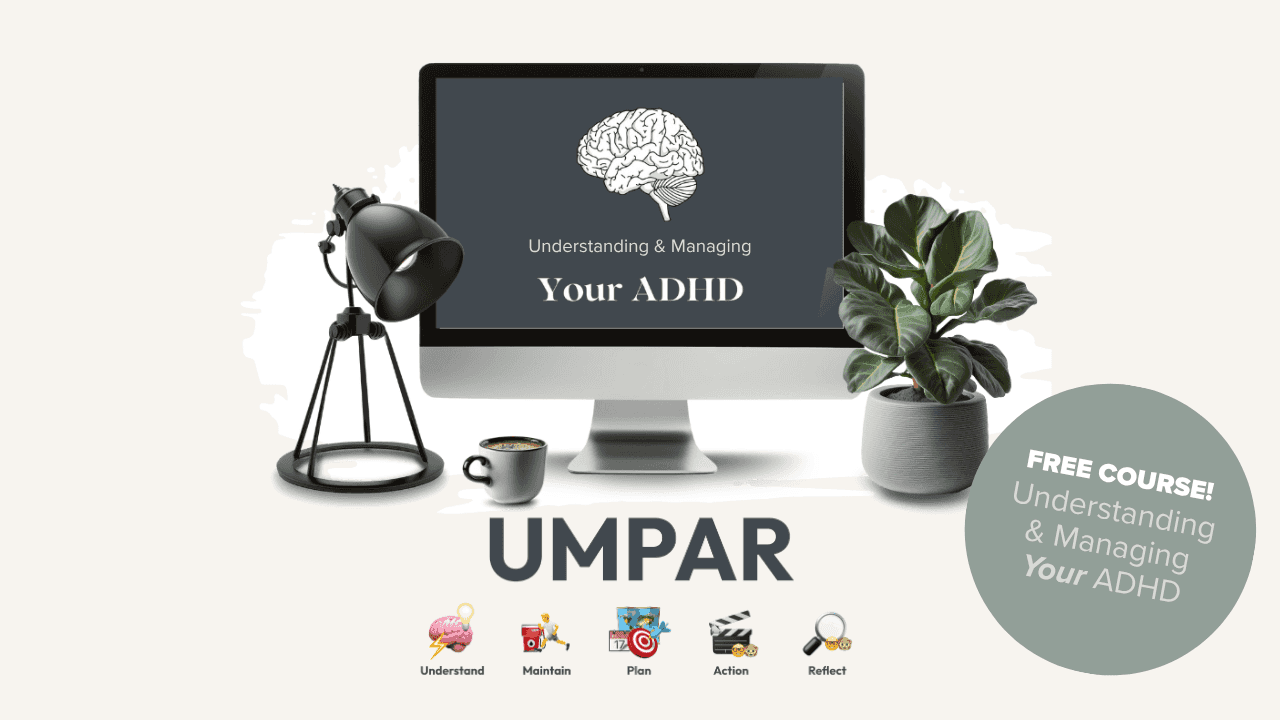
Understanding & Managing Your ADHD
10 modules covering the neuroscience, the U.M.P.A.R. framework, and the practical tools. Everything before the system.
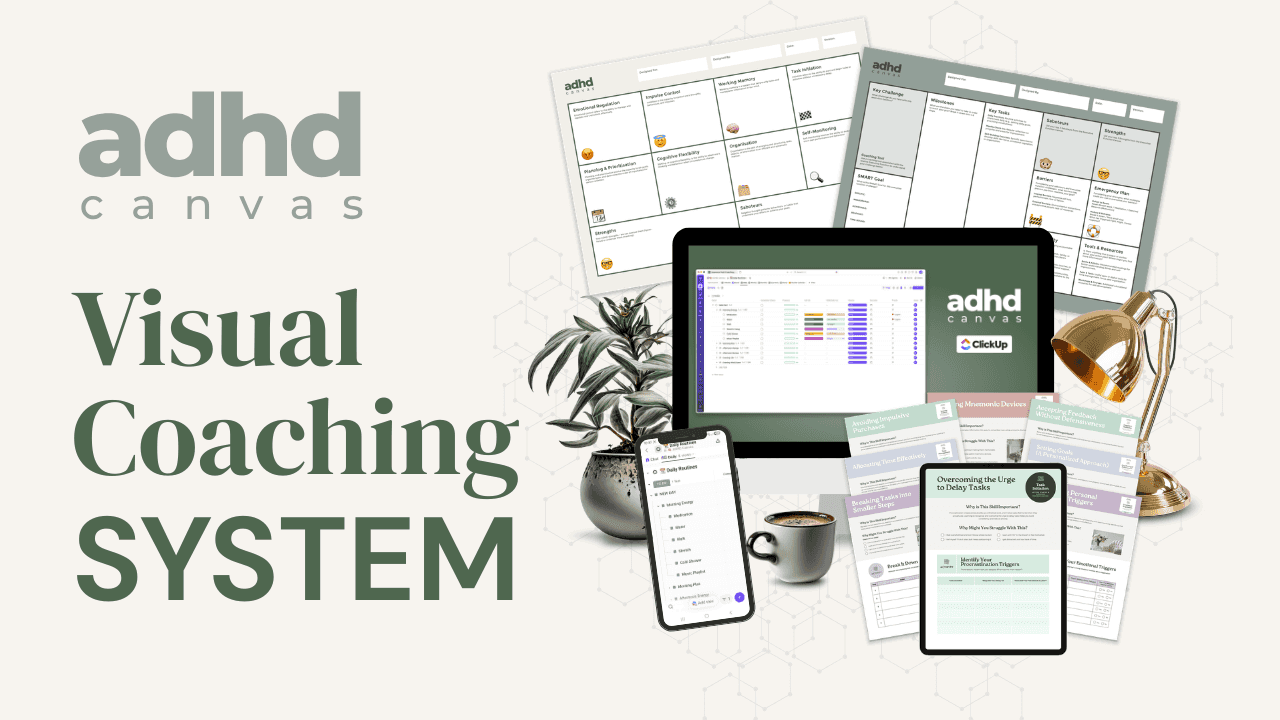
ADHD Canvas + 50 Coaching Tools
Three canvases, 50+ ADHD-friendly tools, and task management with daily reminders built in. The complete system.
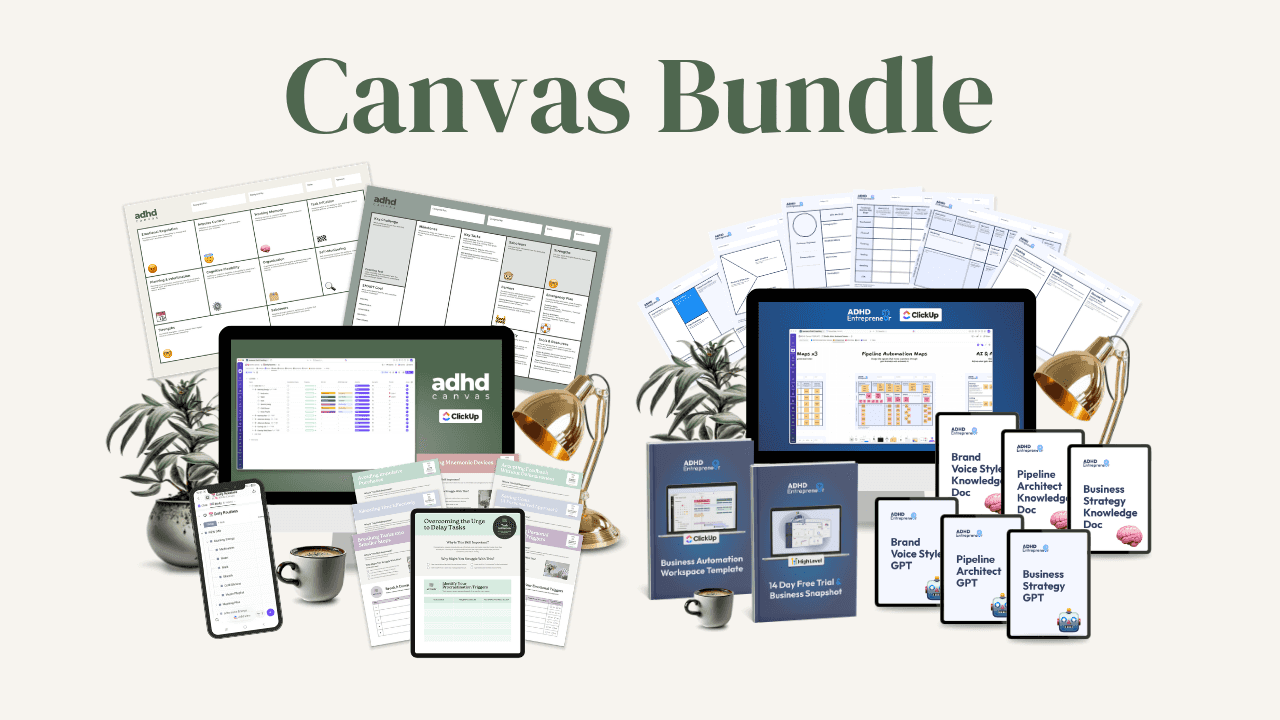
Canvas + Entrepreneur Blueprint
The personal ADHD system and the business automation blueprint together. Understand your brain. Then build a business that works around it.
From people who were exactly where you are.
"Laurence gets it. What I mean is he implicitly understands what it's like to live with ADHD. As a late-diagnosed woman, following a life of masking and challenges, to be given space to unpick, understand, and strategise through open questions, goal setting, and tools is so refreshing."
"Through coaching I have gained so much insight into how my ADHD affects me and how to use different strategies to function. I was getting overwhelmed in my work and personal life, and Laurence has helped me recognise when this is happening and what small, achievable steps to take."

Hi, I'm Laurence.
I spent over a decade as a UX designer and design thinking consultant, helping technology companies understand their users and build systems that genuinely worked for them. Then I was diagnosed with ADHD in my late thirties — and made a connection that changed everything.
The same design thinking principles I had applied to products and organisations could be applied to the experience of living with ADHD. ADHD was not a discipline problem. It was a design problem. That insight became the U.M.P.A.R. framework. And from that framework, the ADHD Canvas was born.
I wrote this because I wish it had existed when I was first diagnosed. A clear way of understanding your brain, and a practical system for designing a life that works with it.
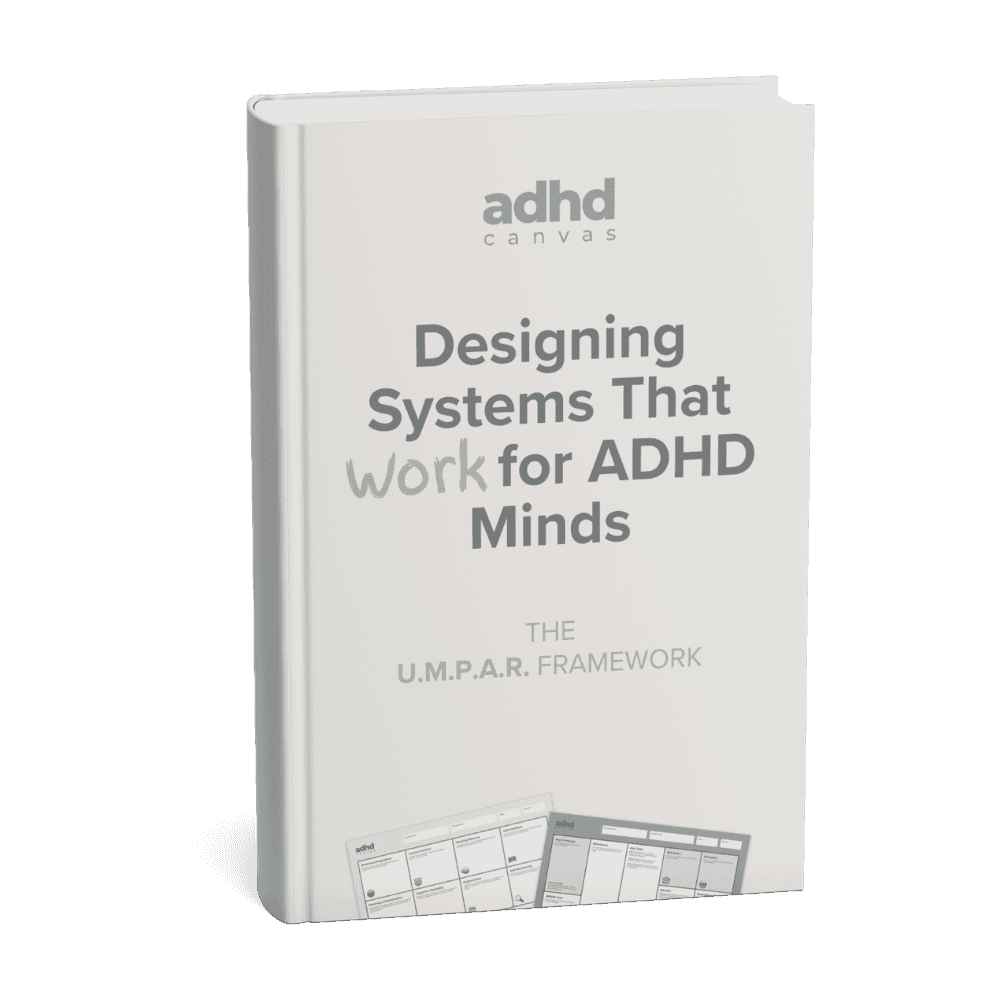
The complete methodology. Written down.
Designing Systems That Work for ADHD Minds: The ADHD Canvas & U.M.P.A.R. Framework is the book I wish had existed when I was first diagnosed. Part One explains how the ADHD brain works and why ADHD is a design problem. Part Two walks through every stage of U.M.P.A.R. in depth. Part Three is the practical guide to the Canvas.
16 chapters. Three parts. Everything in this site — written out properly.
No spam. An early access offer when it's ready.